F-35 Lightning II vs. Sukhoi Su-57: A Modern Stealth Fighter Showdown
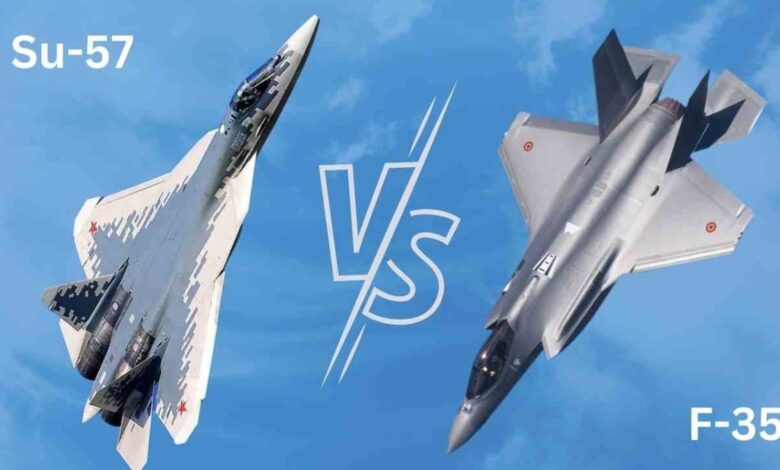

The battle between the F-35 and Su-57 defines modern air superiority. This F-35 vs Su-57 comparison explores their stealth, speed, and capabilities.
In the realm of fifth-generation fighter jets, two names dominate discussions, the American F-35 Lightning II and Russia’s Sukhoi Su-57. Both aircraft aim to define air superiority, but they represent distinct philosophies, strategies, and technological paths. This comparison breaks down their key features to better understand which fighter leads in today’s rapidly evolving defense landscape.
Origins and Development Philosophy
The F-35 Lightning II, developed by Lockheed Martin, is part of a joint strike fighter program led by the United States. It was created with versatility in mind, offering variants for the Air Force, Navy, and Marines. The F-35 was built to prioritize stealth, multirole combat capability, and interoperability among allied forces.
In contrast, the Sukhoi Su-57, developed by Russia’s Sukhoi Design Bureau, focuses on speed, maneuverability, and air dominance. While it incorporates stealth, its design leans more heavily toward agility and raw power. Russia developed the Su-57 primarily to replace older fourth-generation aircraft and challenge Western air superiority.
Stealth and Radar Signature
Stealth is the F-35’s biggest advantage. Its shape, radar-absorbing materials, and internal weapons bay minimize its radar cross-section. This allows it to operate deep into enemy territory without detection.
The Su-57 also features stealth, but not to the same extent. While it includes stealthy design elements and radar-absorbing coatings, its external weapons (in some configurations) and design choices suggest a compromise between stealth and performance. It is stealthier than older Russian jets but doesn’t match the F-35 in radar evasion.
Avionics and Situational Awareness
The F-35 shines in its advanced electronics. It features a Distributed Aperture System (DAS), an Electro-Optical Targeting System (EOTS), and cutting-edge helmet-mounted displays. These tools allow pilots to see in all directions, track multiple targets, and share data with other aircraft and ground forces.
The Su-57 uses modern sensors, but Russia has been less transparent about its full capabilities. It includes infrared search and track (IRST), radar systems, and some sensor fusion. However, many analysts believe the Su-57’s avionics don’t yet match the F-35’s level of integration.
Speed and Maneuverability
This is where the Su-57 excels. Designed for supermaneuverability, it uses thrust-vectoring engines that allow the aircraft to perform complex aerial maneuvers. It is faster than the F-35 and can cruise at supersonic speeds without afterburners (supercruise).
The F-35 is not built for dogfighting. It trades top-end speed and maneuverability for stealth and information dominance. However, in a beyond-visual-range (BVR) engagement, where detection and targeting matter more than close-range agility, the F-35 maintains an edge.
Weapons and Combat Role
The F-35 carries fewer weapons internally, in order to stay stealthy. But it can expand its payload on external hardpoints during missions that don’t require low observability. It excels in precision strikes, surveillance, and air-to-air combat using its sensor advantage.
The Su-57 boasts a higher internal weapons capacity, giving it more firepower while maintaining a lower radar signature than if it carried weapons externally. Russia is developing advanced missiles specifically for the Su-57, including long-range air-to-air and hypersonic weapons.
Cost, Production, and Deployment
The F-35 is expensive, but it is in full-scale production and in service with several NATO countries. Thousands of units are planned across different variants, making it the most widely deployed fifth-generation fighter.
The Su-57, by comparison, is in limited production. Only a handful of units are currently operational. Challenges in engine development and funding have slowed its deployment.
Final Thoughts
The F-35 Lightning II and Sukhoi Su-57 represent two visions of air power. The F-35 offers unmatched situational awareness, networked warfare capability, and stealth. It fits into a modern military strategy where information and precision matter more than raw speed.
The Su-57 brings high speed, agility, and growing stealth capabilities to the table. It’s a potent symbol of Russia’s push to modernize its air force, even if it’s not as widely adopted or integrated as the F-35.
In today’s combat landscape, information often beats brute force. For now, the F-35 holds a technological edge. But the Su-57, with continued development, remains a serious contender.