Political consultant behind fake Biden robocalls posts bail on first 6 of 26 criminal charges
HOLLY RAMER, Associated Press
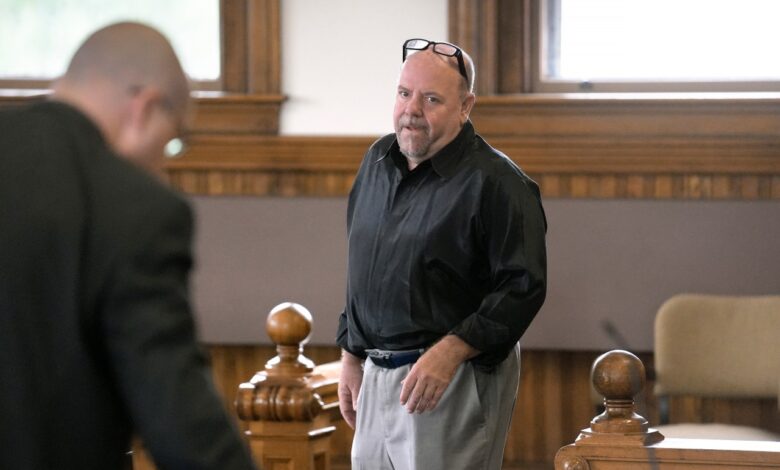
Steve Kramer arrives Wednesday, June 5, 2024, at Superior Court in Laconia, N.H., for his arraignment in connection with charges of voter suppression and impersonating a candidate. Kramer, a political consultant who sent artificial intelligence-generated robocalls mimicking President Joe Biden’s voice to voters ahead of New Hampshire’s presidential primary faces more than two dozen criminal charges. (AP Photo/Steven Senne, Pool)
LACONIA, N.H. (AP) — A political consultant who sent artificial intelligence-generated robocalls mimicking President Joe Biden’s voice made his first court appearance Wednesday in New Hampshire, where he is charged with voter suppression and impersonating a candidate ahead of the state’s first-in-the-nation presidential primary.
Steven Kramer, who also faces a proposed $6 million fine from the Federal Communications Commission, has admitted orchestrating a message that was sent to thousands of voters two days before the Jan. 23 primary. The message played an AI-generated voice similar to the Democratic president’s that used his phrase “What a bunch of malarkey” and falsely suggested that voting in the primary would preclude voters from casting ballots in November.
Kramer was charged last month with 13 felonies alleging he violated a New Hampshire law against attempting to deter someone from voting using misleading information. He also faces 13 misdemeanor charges accusing him of falsely representing himself as a candidate by his own conduct or that of another person.
The charges were filed in four counties and are being prosecuted by the state attorney general’s office.
At Kramer’s arraignment in Belknap County on Wednesday, Assistant Attorney General Brendan O’Donnell successfully argued that Kramer should be ordered to post $10,000 cash bail. He argued that the amount was necessary to ensure Kramer returns to court given that he travels frequently and maintains homes in multiple states.
Kramer’s attorney, Tom Reid, argued for personal recognizance bail. He said Kramer has a long history of appearing at regulatory proceedings and has never missed a court date.
“Traveling a lot doesn’t make someone a flight risk,” he said.
Kramer declined to comment as he left the courthouse. His attorney said he is “enjoying the presumption of innocence.”
“Obviously right now we’re enjoying the presumption of innocence, we’re going to review all the different charges and engage in discussions with the attorney general’s office,” Reid said.
Kramer, who owns a firm that specializes in get-out-the-vote projects, told The Associated Press in February that he wasn’t trying to influence the outcome of the primary election but rather wanted to send a wake-up call about the potential dangers of artificial intelligence when he paid a New Orleans magician $150 to create the recording.
“Maybe I’m a villain today, but I think in the end we get a better country and better democracy because of what I’ve done, deliberately,” Kramer said in February.
Voter suppression carries a prison sentence of 3 1/2 to 7 years in prison. Impersonating a candidate is punishable by up to a year in jail.
Since the New Hampshire robocalls, the FCC has taken steps to combat the growing use of artificial intelligence tools in political communications. In February, it confirmed that AI voice-cloning tools in robocalls are banned under existing law, and on Wednesday, it introduced a proposal to require political advertisers to disclose when they use content generated by artificial intelligence in broadcast television and radio ads.
If adopted, the new rules would add a layer of transparency that many lawmakers and AI experts have been calling for as rapidly advancing generative AI tools churn out lifelike images, videos and audio clips that threaten to mislead voters in the upcoming U.S. election.
The charges against Kramer were announced the same day the FCC proposed its fine, along with a $2 million fine against Lingo Telecom, the company accused of transmitting the calls. The proposed fines were the agency’s first involving generative AI technology, but Lingo Telecom said it strongly disagreed with the FCC’s action, which it called an attempt to impose new rules retroactively.
___
The Associated Press receives support from several private foundations to enhance its explanatory coverage of elections and democracy. See more about AP’s democracy initiative here. The AP is solely responsible for all content.